Steering
From the Multicrew Tank Combat wiki
Contents
Steering is how a vehicle turns. A tracked vehicle turns by running its inner track slower than its outer track, and a wheeled vehicle turns its wheels. The Powertrain card on a vehicle page names the steering of each vehicle. How tight it turns comes from that steering, the gear and the speed, not from a set figure. The transmission and the steering work together: on many tanks the gear you are in changes the turn.
Controls
| Keys | In gear | In neutral |
|---|---|---|
| W + A/D | Drives and turns | Neutral steers, on vehicles that can |
| A/D alone | The outer track drives and the inner track is braked. The vehicle turns around its inner track | Neutral steers, on vehicles that can |
| S + A/D | Brakes and turns as hard as the steering allows | Brakes |
A/D alone gives the tightest turn a tracked vehicle has in gear, and from a standstill it swings the vehicle around its inner track. It also scrubs off speed. W + A/D keeps the vehicle driving through the turn.
A gamepad stick or the touch thumbstick moves the steering only as far as you push it, which gives a wider turn than the keys.
Tracks grip sideways less well than tyres. A tracked vehicle turned hard at speed slides wide of the turn its steering asks for, and the turn costs it speed.
Neutral steering
Neutral steering turns a tracked vehicle about its centre: the outer track runs forward and the inner track runs backward. Select neutral and hold A or D. The Powertrain card shows Neutral steering for the vehicles that can, and the Manoeuvrability group gives their pivot rate.
On vehicles with a hydrostatic differential, holding W as well neutral steers faster.
Types of tracked steering
Clutch-brake steering
The steering lever first disconnects the inner track from the engine, then brakes it. A hard turn brakes the inner track and the vehicle loses speed. W + A/D uses a gentler turn that depends on the gear. These vehicles cannot neutral steer.
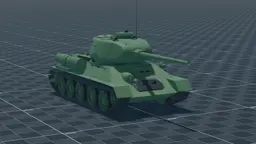
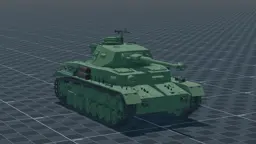
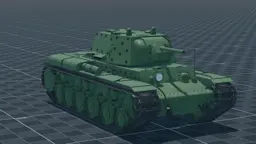
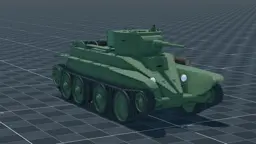
Examples: T-34-85, Pz.IV H, KV-1E, BT-5.
Two-stage planetary
The lever has two positions. The first slows the inner track through a reduction gear, which gives the same wide turn in every gear. The second stops the inner track for a tight turn. W + A/D uses the first position, except in 1st gear, where it uses the second. A/D alone and S + A/D always use the second. These vehicles cannot neutral steer.
Examples: T-55, T-62, ZTZ96A, BMP-2.
Planetary side gearboxes
Each track has its own gearbox. Steering drops the inner track one gear below the outer one, and the turn changes from gear to gear. In 1st gear and reverse there is no lower gear, and the inner track is braked instead.
Most of these tanks cannot neutral steer. A few can, with the inner track in reverse while the outer runs forward. The Powertrain card shows which.
Examples: T-72B, T-80U, T-90M. With neutral steering: BM Oplot, Al-Khalid.
Controlled differential
A controlled differential slows the inner track and passes the power it takes away to the outer track. The vehicle keeps its speed through a turn instead of braking. Several designs share this label:
| Design | How it turns | Examples |
|---|---|---|
| Merritt-Brown | One turn per gear, wider in higher gears. Neutral steers | Centurion Mk.10, Churchill VII, Cromwell V |
| Allison cross-drive | One turn per gear. Neutral steers | M48A3 Patton, Merkava Mk.1B |
| German two-radius | Half the lever gives a wide turn, full lever a tight one. Neutral steers | Panther G, Tiger I |
| Fixed-ratio differential | The same turn in every gear. Cannot neutral steer | M4A1 Sherman, M113 |
| Other regenerative gearboxes | One turn per gear. Most neutral steer | Chieftain Mk.5, Leopard 1A5, Type 87 |
Hydrostatic differential
A hydraulic pump and motor add a speed difference between the tracks on top of the drive. The turn follows the lever smoothly, with one circle per gear at speed, and it tightens as the vehicle slows. Nearly every vehicle with this steering can neutral steer.
Examples: Leopard 2A4, M1 Abrams, Challenger 2, Type 90, K2, BMP-3 (1987).
Electric drive
The Powertrain card of the Maus, the Porsche Tiger and the Elefant shows a hydrostatic differential. They steer with an electric motor on each track instead (see electric drive). Pushing the lever further slows the inner motor, and at full lever runs it backward: the Maus then turns about its centre even in gear. All three can neutral steer.
Wheeled vehicles
A wheeled vehicle steers with its front wheels. The faster it goes, the wider it turns, which keeps it from sliding out. Wheeled vehicles cannot neutral steer, with two exceptions that skid-steer like a tank: the AMX-10RC and the BTR-90.
The GTK Boxer FLW 200 also brakes its inner wheels when steering hard at low speed, which tightens the turn.