Transmission
From the Multicrew Tank Combat wiki
Contents
The transmission (gearbox) turns the power of the engine into pulling force at the tracks or wheels. Every vehicle has its own gearbox, with its own gears and way of shifting. The Powertrain card on a vehicle page names the transmission, its type and its number of gears. The Gearing card lists every gear with its ratio and the fastest the vehicle goes in it.
Shifting
E shifts up and Q shifts down. The gear lever on screen can also be dragged through its gate while holding Left Shift, and Left Ctrl works the range lever on vehicles that have one. W is the accelerator in every gear, including reverse. S is only the brake: it never selects reverse. Reverse sits below neutral, and W drives backward in it.
A gearbox refuses a downshift that would push the engine past its top speed. You cannot drop from top gear into 1st to brake. The downshift goes through once the vehicle has slowed to the lower gear's top speed. A shift into reverse while moving forward, or the other way round, is refused for the same reason.
A vehicle spawned for a solo crew shifts by itself, whatever its gearbox. S then brakes to a stop and backs up.
Gears
Every gear has a top speed, shown on the Gearing card. It is where the engine reaches its highest speed in that gear. In top gear that is the vehicle's Vmax. A lower gear pulls harder and tops out sooner.
On most tanks, 1st gear is low enough to pull 65% of the vehicle's weight, enough for the steepest slopes a tank can climb. Wheeled vehicles have a normal 1st gear instead.
Most vehicles have one or two reverse gears. A few have many more, such as the T-84: its reversing gear gives it five reverse gears and up to 31 km/h backwards.
Types of transmission
| Type | How it drives | Examples |
|---|---|---|
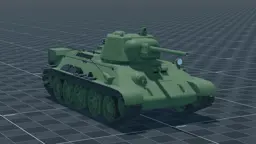
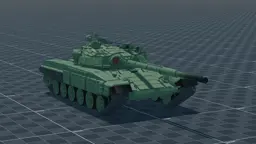
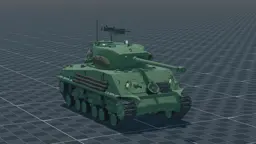
| Manual | You pick every gear, and the drive cuts out while you shift | T-34, T-72B, M4A3E8 Sherman |
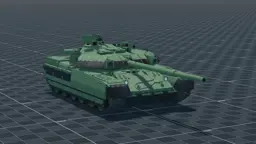
| Automated manual | A manual gearbox that shifts itself | T-90M, T-14 Armata |
| Torque converter automatic | Shifts itself, and multiplies the engine's pull when moving off | Type 90, Merkava Mk.4M, ZTZ99A |
| Hydromechanical | No fixed gears, with a few speed ranges | M2A3, M270 MLRS |
| CVT | No fixed gears at all | Abrams X, Object 450 |
| Electric | The engine runs a generator, and electric motors drive the tracks | Maus, Porsche Tiger, Elefant |
Manual
A manual gearbox stays in the gear you pick. Starting in too high a gear bogs the engine down to 12% of its pull.
The clutch slips while the vehicle pulls away. Lifting off in gear lets the vehicle slow to a crawl at idle instead of stopping. Below that crawl nothing holds the vehicle. On a slope it rolls back until you brake.
Some vehicles shift by hand through an H-shaped gate. The T-90M's automatic shifting will not drop into 6th, 5th or 4th when the engine would over-rev, and leaves the lower gears to you.
Automatic
An automatic gearbox has a selector instead of single gears. The usual one is R, N and D: E moves from R to N to D, and Q back. In D the gearbox shifts up and down by itself. It drops a gear when you floor the throttle and the lower gear pulls harder. It does not shift up while braking.
Some vehicles have more positions, and each one limits which gears the gearbox can use.
| Vehicle | Positions |
|---|---|
| M1 Abrams family | D uses gears 2 to 4 and moves off in 2nd. L uses gears 1 to 4 and moves off in 1st |
| GTK Boxer FLW 200 | D uses gears 2 to 7 and moves off in 2nd. 1 holds 1st |
| Type 10 | D uses every range. L holds the first range |
| M113 | 1-3, 2-3, 1-2 and 1 |
An automatic in gear with the pedal up creeps forward at walking pace. Stopped on a slope in gear, it holds the vehicle without the brake.
Torque converter
A torque converter is a fluid coupling between the engine and the gearbox. While the vehicle is moving off, it multiplies the engine's pull. The figure is largest at a standstill and fades out as the vehicle speeds up. Some gearboxes then lock the converter up to stop it slipping. The Allison CD-850 never locks, and always loses a little pull to slip.
| Gearbox | Pull at a standstill |
|---|---|
| GM Torqmatic (M18 Hellcat, M26 Pershing) | 480% |
| Allison CD-850 (M48A3 Patton) | 400% |
| ZF 4 HP 250 (Leopard 1A5) | 280% |
| BMP-3 hydromechanical (BMP-3 (1987)) | 270% |
| RENK HSWL 354 (Leopard 2A4) | 250% |
| SNT Dynamics EST15K (K2) | 230% |
| David Brown TN54E (Challenger 2) | 220% |
The M1 Abrams has an Allison X1100 at 220%, and the extra pull of its gas turbine at a standstill comes on top of that (see gas turbines).
Continuously variable and hydromechanical
These gearboxes have no fixed gears. The engine stays at the speed that gives the power you ask for, and the drive never cuts out. A hydromechanical gearbox still has a few speed ranges. On the M2 Bradley family, L holds the first range, which keeps speed low and brakes hard when you lift off.
They neither creep nor roll back: in D they hold the vehicle on a slope.
Electric drive
With electric drive, the engine turns a generator and an electric motor drives each track. Engine speed follows the throttle, not the vehicle's speed. There are no gears and no shifts. Each track has its own motor, which also steers the vehicle.
Retarder
A retarder is a brake built into the gearbox. When you lift off, it makes engine braking 250% as strong. The RENK HSWL gearboxes of the Leopard 2 family, the KF51 Panther, the PUMA S0 and the KF41 Lynx have one, as does the Leclerc S21.
Gradeability
Gradeability is how steep a slope a vehicle can climb. The steepest slope has one of two limits:
| Limit | What it means |
|---|---|
| Traction | The tracks or wheels slip before the engine runs out of pull |
| Power | The engine and gearbox cannot pull the vehicle up anything steeper |
Some vehicles can keep climbing a slope they cannot start on. When a vehicle with a manual gearbox pulls away, its engine runs close to idle, where it pulls less than at speed. If it stops on a steep slope, it may not be able to move off again. A torque converter or a gas turbine does not have this problem: both pull hardest from a standstill.